
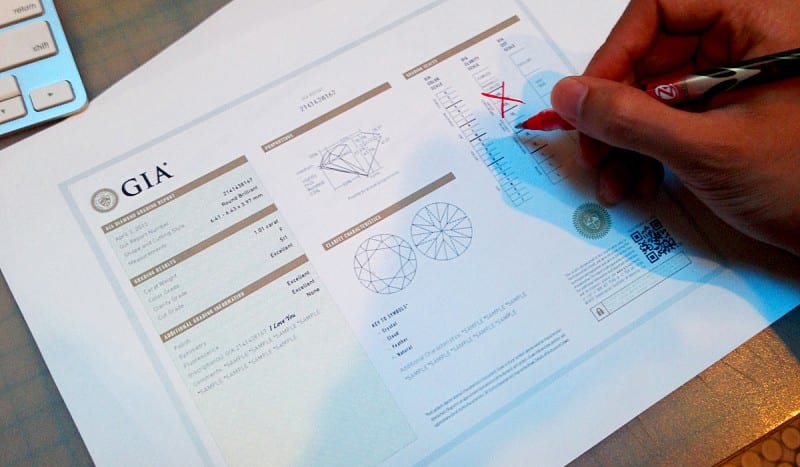
We’ve been pretty cynical about the whole process of buying an engagement ring—lots of anxiety, lots of money, lots of ways to screw it up—but in this one, singular case, the “Grading Report” is actually kind of cool.
Think about it. Imagine if you had a “Grading Report” for your girlfriend/fiancée that would tell you all the flaws, all the good qualities, all the possible cracks and fissures. That would actually be pretty useful, right, and help you figure out if She’s The One?
When read properly, the grading report can unlock the secrets to any diamond, and even give you the confidence to buy a diamond you have never seen in person from an online store. Careful. All grading reports are not created equal, and they’re complicated enough, cryptic enough, that you might want an expert to review a report before you seal the deal.
You have questions. We have answers.
Okay. So what exactly is a “grading report?”
A grading reports issued by an independent laboratory accurately describes the clarity, color, fluorescence, proportions, symmetry, and weight of a diamond. “Independent” means the lab has no vested interest in buying or selling diamonds.
Sounds like a real hoot. Anything else on there?
It also provides a “plot” of the diamond that maps all of the unique, microscopic characteristics and flaws. This is the best tool to use when judging a diamond.
You waited this long to find “the one” — the ring deserves equal scrutiny. At James Allen and Blue Nile, you can view diamonds from all angles — 360 degree rotation — to see how different “clarity” grades really look.
Can you show me an example?
You bet. Click here for an example of a grading report issued by the Gemological Institute of America (GIA).
How seriously should I take these things?
Don’t take the grading report lightly. Some merchants might show you a piece of paper and say that a diamond is “certified,” which gives the impression that you needn’t look or analyze further. There’s actually no such thing as a “certified diamond.” This term may sometimes be used to describe a diamond that has a laboratory-created grading report. If this is the case, make sure the laboratory is one of the ones we recommend below.
Is there a particular grading report I should look for?
Not all grading reports are created equally. The majority of grading reports, unfortunately, don’t provide enough information about the quality of a diamond. Therefore it’s almost impossible to determine if it’s priced correctly. We recommend the Gemological Institute Of America (GIA) grading reports issued after 1997 with the new cut grade and full plot (a diagram marking all of the stone’s unique, microscopic characteristics and flaws), and the American Gem Society (AGS) grading reports. These reports are the most objective, consistent, and detailed. The New GIA and AGS reports also fully analyze the cut of a diamond, compared with other reports that only disclose a diamond’s color, clarity and carat weight. Cut represents up to 50% of the price of a diamond and 100% of its sparkle. In addition, the GIA and the AGS only assess loose diamonds and they have multiple gemologists evaluating each stone.
That was really boring.
We know. It’s good preparation for your marriage.
Anything else I should know about GIA reports?
GIA Diamond Dossier reports, which are similar to the full GIA diamond-grading reports but designed specifically for diamonds under two carats, don’t include a diagram marking all of the stone’s unique, microscopic characteristics and flaws. Without this “plot,” it would be impossible to determine if the clarity of your diamond poses durability issues or could potentially be fracture filled.
Bigger isn’t always better. Look for super sparkle at sites like Whiteflash, Brian Gavin, and James Allen. They are known as go-to sellers of ideal cut diamonds.
Okay, okay. But what if there’s a store merchant who says I don’t need a lab grading report…because he does all the plot and grading himself?
Whoa. Red flag. Why wouldn’t the store invest in the best grading report possible? One answer could be because the diamond grades are not, well, what the store is representing. If you find a diamond you love, ask the store if they will send it out to GIA or AGS for a full grading report. It’s customary for them to ask for you to guarantee that you’ll buy if the diamond comes back as the store had graded it. It is also common practice for the store to ask you to absorb the expense of the grading report, but you can usually bargain a bit on this request.
Given the cost of a grading report, isn’t it silly to require them for stones of a certain size?
Dossier grading reports from GIA are available for diamonds that range from .15 carat to .49 carat at a charge of $36-$42. Even in this small diamond size range, it is worth the money.
Really?
Really. You may not think it matters if a diamond at that price point is a G or H color—but what this report guarantees is that your “diamond” is even a genuine diamond. That alone justifies the grading report. Once diamonds reach the 1/2 carat range we would recommend the full diamond grading report (not just the dossier) where you can also view the microscopic inclusions in your diamond. This plot gives you an idea of whether or not you will see the inclusions with your eye (not under magnification) and suggests the probability of durability issues. This service costs $64 for diamonds .47 carats- .69 carats. If the diamond has already been graded the cost of the report is already “baked into” the price you are being quoted.
Read more: https://www.theplunge.com/ringbuyingguide/diamond-ring-grading-reports#ixzz2LqZaY3AE